1859 train wreck near Mishawaka kills dozens in a flooded ravine
The accounts of the Night Express disaster between South Bend and Mishawaka disagree on how many died, and one family's graves were never moved from the city cemetery.
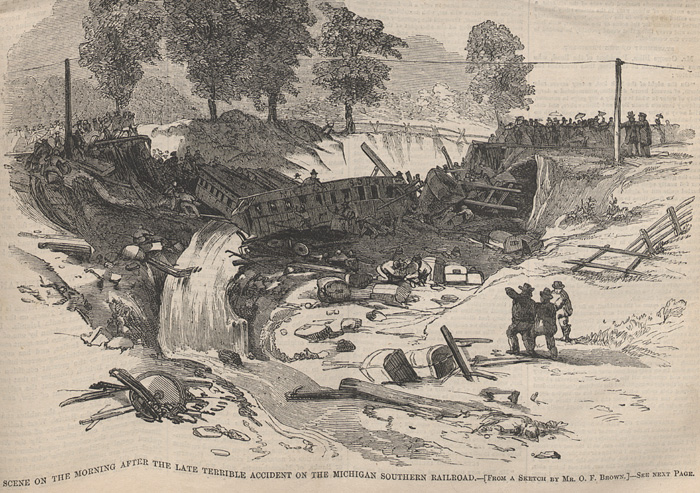
The president of the railroad was on the train.
When the Night Express from Chicago to Toledo went into a ravine between South Bend and Mishawaka a little before midnight on June 27, 1859, the road's president, a Mr. Bliss, and a director, Hiram Sibley, were in the sleeping car. Both escaped unhurt, according to a Chicago Journal account of June 28, reprinted two days later in the Davenport (Iowa) Daily Leader.
A history commissioned by the City of Mishawaka, written by Peter J. De Kever, puts about 150 people on the train. Many did not escape, and the accounts never agreed on how many.
De Kever's history calls the railroad's arrival in Mishawaka, on Oct. 4, 1851, one of the most significant events in Mishawaka history. It says the railroad also brought the city's greatest tragedy.
A rivulet becomes a torrent
The eastbound train, on the Michigan Southern & Northern Indiana, was due in Mishawaka at 11:27 p.m., according to De Kever. He places the wreck at the Springbrook Ravine, just west of today's Ironwood Drive, and says heavy rains had washed out an embankment and stone culvert there. The Chicago Journal reported that the embankment gave way and the whole train went into the ravine, which the paper said was filled with a torrent of water.
The Journal described the stream as ordinarily a rivulet, swollen by extraordinary rains the previous afternoon and evening. The paper offered a theory, not a finding: floodwood had probably blocked the culvert, turning the embankment into a dam. A westbound train had crossed safely at 8:30 p.m., the Journal said. A Cleveland dispatch of June 28, printed in the Erie (Pa.) Observer on July 2, said the westbound train passed safely three hours before the accident.
The sources do not agree on the basic measurements. The Journal and the Cleveland dispatch had the train running 10 to 20 miles per hour; De Kever's history gives 25 to 30. The Journal put the ravine at about 25 feet deep and 75 to 100 feet wide; the history says 30 feet deep and 100 feet wide. The Journal added that the night was very dark and that there was a curve just before the embankment.
By the Journal's account, the engine was buried in quicksand and mud in the opposite side of the ravine. The tender, the baggage and express car and two second-class cars were shattered and piled on top of it. Two first-class cars were torn apart and carried down the stream. The sleeping car went over with the rest but was less damaged.
A passenger in that car, J. J. H. Rice, told the Journal that the first he knew of trouble was water rushing over the cars. The lights were out, and only occasional lightning let him see. He jumped, landed in the torrent, reached some bushes and climbed the bank. "The cries of distress were awful," he said.
Rice said the conductor, William Osgood, ran to South Bend and to Mishawaka and back, about eight miles, without his hat. De Kever writes that Mishawakans were awakened about 12:30 a.m. by church bells calling them to bring aid. The Journal reported that citizens of both towns turned out en masse to help the wounded and search for the dead. According to the history, swift, deep water and darkness thwarted rescue. One woman, the Journal said, was carried downstream toward the river but lodged in a treetop.
The U.S. Express safe, holding over $30,000, broke apart in the crash, the Journal reported; the agent found most of the money in the ruins. A through mail bag was found near the river, 200 yards from the break.
Five counts of the dead
The death toll changed with each telling. The Cleveland dispatch of June 28 reported 33 taken from the ruins dead and 57 wounded. The Chicago Journal reported 60 dead and 50 or 60 wounded. An additional South Bend dispatch that evening, carried with the Journal account, said 34 bodies had been found up to 10 p.m. and that 17 of the dead could not be identified. The Chicago Press of July 2, reprinted in the Davenport Daily Gazette two days later, put the total found so far at 41. De Kever's history says at least 39 were killed and 42 injured.
The history says the injured were taken to nearby houses. Thirty-two dead were first laid beside the track and later brought to the Mishawaka depot until claimed.
The Journal named four men working on the train among the dead: the engineer and fireman, both named Chulp, of La Porte; an express man named Hartwell, of Toledo; and the baggage master, Babbington. The additional dispatch listed two boys named Tideswell among the dead.
None of the sources reviewed reports a finding of fault by any inquest or court. The Journal and the Cleveland dispatch both said the passengers did not blame the train's officers. "No fault is attributed to the officers of the train by the passengers," the Cleveland dispatch said.
Bodies were still being found days later. U.S. Rep. Schuyler Colfax sent the Chicago Press a note, written on the cars, reporting that two bodies were taken out of the ravine Thursday afternoon, completely buried in the sand. One was named Campbell; the other was not known. The Press also reported that the body of a Miss Regan was found in the St. Joseph River less than a mile below the creek. She was identified by her dress by a Mr. Whinery of South Bend, at whose house her mother had died.
Before rebuilding of the culvert began, the Press reported, the people of Mishawaka decided at a public meeting Wednesday evening to excavate the ground to see whether more bodies could be found.
Railroad service resumed after a stronger bridge was built over the ravine, De Kever writes. Fifteen victims were initially buried in Mishawaka City Cemetery. All were later exhumed and taken by their families except a mother and her children. The history spells their name Tidswell.
- Peter J. De Kever, Mishawaka: A History (City of Mishawaka)(opens in a new tab)
- Mishawaka: A History (City of Mishawaka website)(opens in a new tab)
- 1859 newspaper accounts transcribed on RootsWeb St. Joseph County: Chicago Journal, June 28, 1859 (in Davenport Daily Leader, June 30, 1859); Cleveland dispatch, June 28, 1859 (in Erie Observer, July 2, 1859); Chicago Press, July 2, 1859 (in Davenport Daily Gazette, July 4, 1859)(opens in a new tab)
- Harper's Weekly, July 16, 1859, p. 449: Scene on the morning after the late terrible accident on the Michigan Southern Railroad(opens in a new tab)
This story was written with AI from the sources above. See something wrong? Tell us and we will correct it.
Comments
No comments yet.
Comments use your real name. To keep out fake accounts, we verify a US mobile number by text. We never show or share your number. Comment guidelines
Commenting as .
Replying to a comment.
Be civil and stay on topic. Criticism of anyone, including this paper, is welcome. Comments are reviewed before they appear. Guidelines
Comments open soon.