Mayor vetoes 1903 franchise for line that became South Shore
Edward J. Fogerty said the grant had to come through the Board of Public Works. The council overrode him 7-3, then sent the job to that board.
Twice in the spring of 1903, the mayor of South Bend vetoed a franchise for the railway that would become the South Shore Line.
The company was then the Chicago & Indiana Air Line Railway Company, an "inter-urban" line in the city's records. It wanted to run cars on South Bend streets. An ordinance authorizing it to use certain streets got its first and second readings in the Common Council on Feb. 23, 1903.
Mayor Edward J. Fogerty would not sign.
His veto of an ordinance granting the company use of certain streets and alleys was filed with the city clerk April 18 and read to the council April 27. He had "concluded it is my duty to veto the ordinance," he wrote. The ordinance required a $10,000 bond to protect the city during construction; Fogerty wrote that a sufficient bond should be required "during the entire term of the grant." He urged that safeguards go into an ordinance that "should come through the proper channels," to avoid "interminable and costly controversies in the Courts."
At the same meeting, the petitions were read.
Twenty labor unions asked the council to grant the franchise. So did a petition of business men, and one from 17 physicians and 40 lawyers. More than 1,000 voters "of the Polish Nationality" signed another; 344 voters "of the Swedish nationality" signed a fifth. Nineteen La Salle Avenue property owners wanted it only on conditions, among them no freight cars on their street.
A second veto, and a legal question
The council met at 7:45 p.m. on May 25. Fogerty presided, and he returned a second ordinance "without my approval."
He did not overlook its concessions to the city, he wrote. But "it is clear that the ordinance lacks an important statutory prerequisite, necessary to give it validity." The City Charter, he explained, gave the power to authorize use of streets for railway purposes to the Board of Public Works, by contract. The council's part was to approve that contract.
He attached an opinion from the city's Department of Law, signed by Shively. The charter, it said, lets the board "authorize and empower by contract ... street car or railway companies to use any street, alley or public place." And: "Where the power to act resides, there the duty to act is imposed." The ordinance, the opinion concluded, "is invalid for the reason that its subject matter has not been legally before the Council."
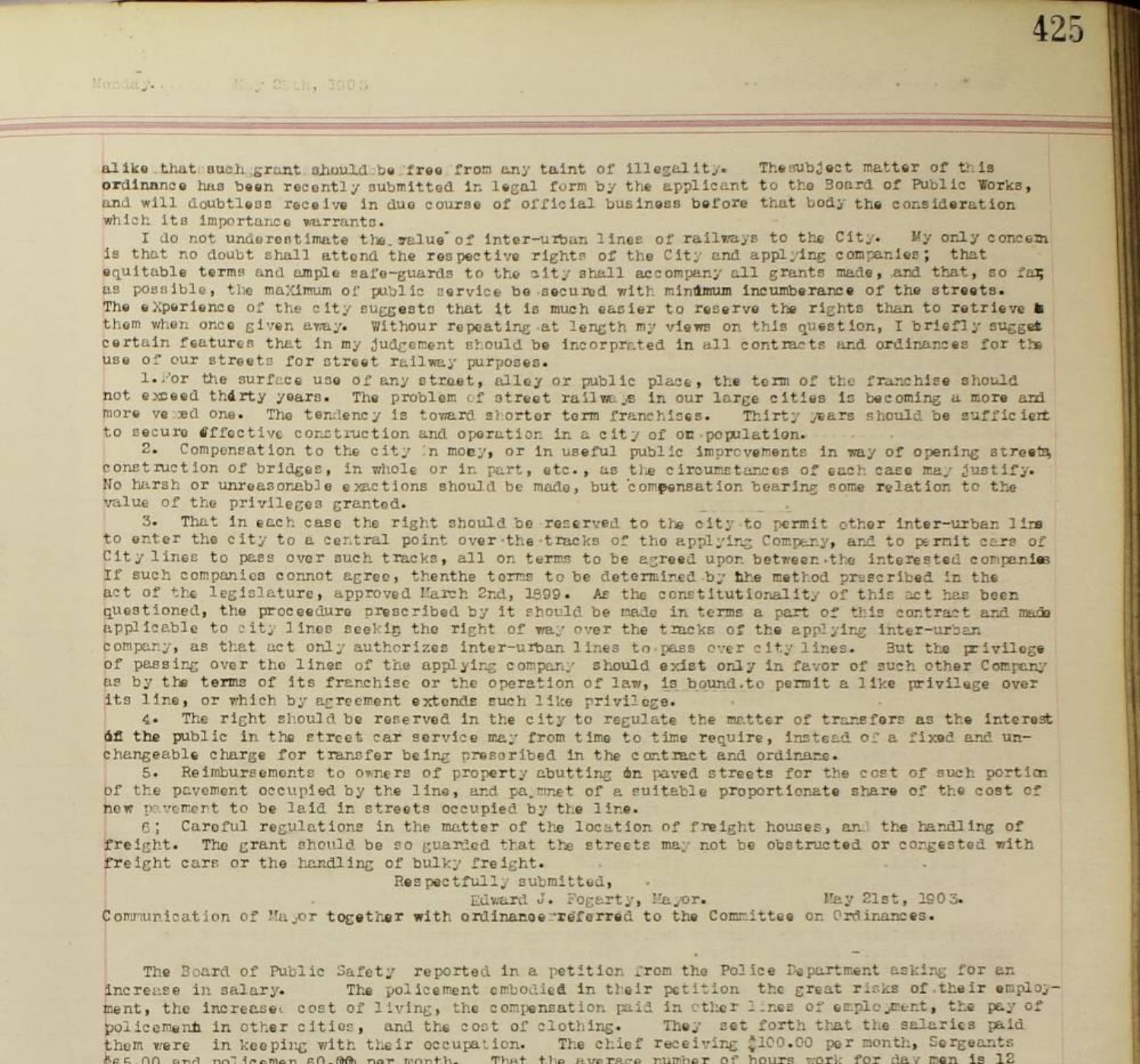
Fogerty's message, dated May 21, also said: "I do not underestimate the value of inter-urban lines of railways to the City." And: "The experience of the city suggests that it is much easier to reserve the rights than to retrieve them when once given away."
He listed six features he wanted in "all contracts and ordinances for the use of our streets for street railway purposes." A term that "should not exceed thirty years," because "The tendency is toward shorter term franchises." Compensation to the city in money or in public improvements such as opening streets or building bridges, with "No harsh or unreasonable exactions." The right for other interurban lines, and city cars, to use the applicant's tracks to reach a central point. The city's right to regulate transfers. Reimbursement to abutting owners for the pavement the line occupied. And regulation of freight, so streets "may not be obstructed or congested with freight cars or the handling of bulky freight."
On June 8, the Committee on Ordinances, Gustav A. Stueckle and J.H. Hartzer, recommended passing the ordinance over the veto. Passage, they wrote, would be "largely to the enterprise and promotion of our City" and was "demanded by nearly four thousand voters."
On a rising vote, Councilmen Elbel, Montgomery, Hartzer, Stueckle, Koszorowski, Whiteman and Kucharski stood in favor. Schreyer, Loughman and Somers stood against. Seven to three. The ordinance was declared passed over the veto.
Then Councilman Montgomery moved that the Board of Public Works draw up a form of contract "conforming to the ideas of the Council as expressed in the ordinance" and present it for ratification. It carried. That was the route Fogerty and the law department had described: the board writes the contract, the council approves it.
On Aug. 24, an ordinance ratifying a contract between the city, "by and through its Board of Public Works," and the company reached the council. The Committee on Ordinances later reported the contract was "in conformity with the franchise as passed by the Common Council." A 1905 city ordinance records that the contract was executed Aug. 24, 1903, and is Ordinance No. 1214.
By August 1905, that ordinance says, the company "is now known by order of the St. Joseph Circuit Court as the Chicago, Lake Shore & South Bend Railway Company." It wanted more time to build, and a new route because of the Winkler Brothers' factory.
Records at the Indiana Historical Society trace that railway to a 3.5-mile track from East Chicago to Indiana Harbor in 1901. "In 1908 the line was electrified and connected the cities of South Bend and East Chicago," the society's finding aid says. After a 1925 bankruptcy and purchase by Samuel Insull, it became the Chicago South Shore and South Bend Railroad. The Northern Indiana Commuter Transportation District later took over its passenger service, today's South Shore Line.
It began, in South Bend, as a franchise a mayor vetoed twice and a council passed anyway.
More stories about South Bend Common Council
- Common Council minutes, Feb. 23, 1903 (Minute Book 18, p. 401)(opens in a new tab)
- Common Council minutes, April 27, 1903 (Minute Book 18, p. 416): Fogerty veto message(opens in a new tab)
- Common Council minutes, April 27, 1903 (Minute Book 18, p. 418): end of veto, petitions(opens in a new tab)
- Common Council minutes, May 25, 1903 (Minute Book 18, p. 424): second veto and law department opinion(opens in a new tab)
- Common Council minutes, May 25, 1903 (Minute Book 18, p. 425): Fogerty's six conditions(opens in a new tab)
- Common Council minutes, June 8, 1903 (Minute Book 18, p. 428): veto override(opens in a new tab)
- Common Council minutes, Aug. 24, 1903 (Minute Book 18, p. 445)(opens in a new tab)
- Common Council minutes, 1903 (Minute Book 18, p. 447): committee report on contract(opens in a new tab)
- Ordinance No. 1323, Aug. 1905 (Ordinance Book 4, p. 277)(opens in a new tab)
- Indiana Historical Society, Chicago South Shore and South Bend Railroad Records finding aid(opens in a new tab)
This story was written with AI from the sources above. See something wrong? Tell us and we will correct it.
Comments
No comments yet.
Comments use your real name. To keep out fake accounts, we verify a US mobile number by text. We never show or share your number. Comment guidelines
Commenting as .
Replying to a comment.
Be civil and stay on topic. Criticism of anyone, including this paper, is welcome. Comments are reviewed before they appear. Guidelines
Comments open soon.