Site of South Bend's first Black church becomes city landmark
Olivet A.M.E. built the Monroe Street church in 1917; the city bought it for the Coveleski Stadium project in 1986, and Zion Hill has kept it since.
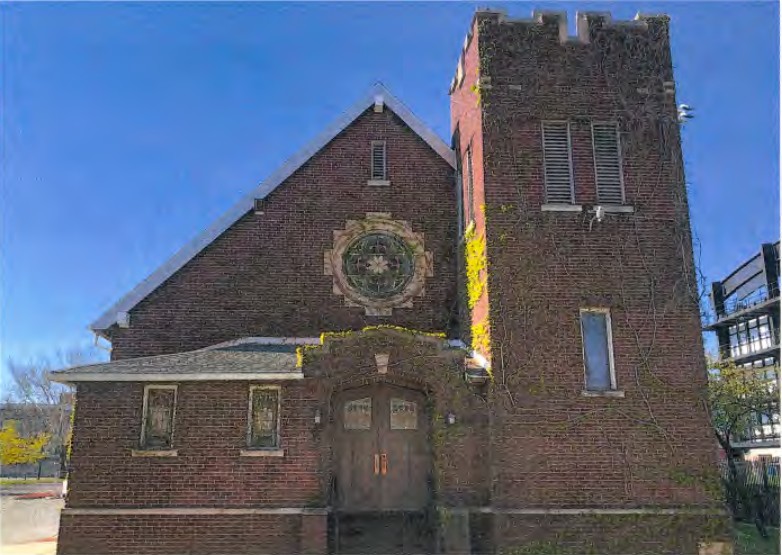
In 1994, the City of South Bend set its price for the brick church at 310 W. Monroe St.: $75,400.
Zion Hill Missionary Baptist Church, which had been renting the building for eight years, opened at $1.
The congregation pointed to the rent it had already paid and to nearly $50,000 it wanted to put into renovations, according to the IU South Bend Civil Rights Heritage Center's encyclopedia entry on the church. By the end of the year, the two sides settled on $10,000. Three years later, the congregation held a mortgage-burning ceremony.
On Aug. 10, 2026, the same city made the building a historic landmark. The Common Council passed Ordinance 11300-26 with seven ayes and two members absent, designating the church "with its surrounding grounds and structures, but excluding the parking lot." Zion Hill, the owner, had asked for it.
The ordinance calls the site "a publicly accessible surviving structure from the first African-American church congregation organized in South Bend."
Nine charter members
That congregation was Olivet African Methodist Episcopal Church, organized in 1870 "under the direction of Reverend John Bundy and nine charter members," according to the ordinance. Articles of Association dated March 16, 1871, made it a legal entity under the name "Olivet Chapel Society of the African Methodist Episcopal Church of South Bend." James Hurst, Pharoah Powell, J. H. Jackson, Catherine Wilson and Alice Fowler signed.
The first trustees bought the Monroe Street site that same year. A first church went up "in the late 1870's under the direction of Rev. Bundy," the ordinance says, and was later remodeled. "For many years," the ordinance adds, "it was the only center of the social, religious, and political life of the city's African-American community."
The building that stands today came later. "Late in 1915 plans were made for a new church during the administration of Reverend C. Emery Allen," the ordinance says. It was dedicated Feb. 4, 1917, by Right Reverend C. S. Smith, the presiding bishop, during the Michigan Annual Conference. A pipe organ was unveiled that October.
The ordinance describes a Gothic Revival church of "stretcher bond wire cut brick with cut and dressed stone," with a steeply pitched roof, pointed-arch stained glass windows, a circular window in the front pediment and "a crenelated tower at the northwest front corner." The front double doors "together have a Tudor arched head." The sanctuary sits under a high vaulted ceiling, with a large room in the basement below.
The Indiana Historic Sites and Structures Inventory rated the structure "Significant/Notable" and called it "unaltered and in good condition."
Olivet outgrew it. The ordinance and the city's staff report say that "In 1969, the Olivet A.M.E. Church purchased the former Lowell Heights Methodist Church at 719 N. Notre Dame Avenue." Olivet's own 2026 letter puts the move in "the early 1970s." The Civil Rights Heritage Center entry says the congregation "left the building in 1969, sparked by their congregation outgrowing the space and also by a belief that downtown redevelopment in the wake of Studebaker's closure would force their hand."
Olivet sold the church to James and Bonnie Baxter, who turned it into a center for dance instruction and performance. The heritage center entry says it was a studio for the Southold Dance Theater in 1975; the ordinance names the 1981 seller as "Southhold Dancecenter Inc." In late 1981 it became a sanctuary again, for a United Pentecostal congregation the entry calls Greater Christian Tabernacle and the ordinance calls "the Greater Tabernacle Christian Church."
Twenty feet from a ball game
Then the city decided to build a ballpark next door.
In 1985, according to the heritage center entry, city leaders released a list of 23 nearby sites for purchase and possible demolition. The church was not on it. Its pastor, Rev. Michael Friend, had struck a deal to sell the building the day before the mayor announced the stadium plans. He had not signed it.
"Boom. The deal was off. … Who wants to hold services within twenty feet of a ball game?" Friend said, as quoted in the heritage center entry.
Friend asked that the church be added to the list. The city offered $130,000. The other 23 properties, the entry notes, had a combined value of $338,616.
South Bend Tribune commentator Ray Gard weighed in. "A home run ball, thumping down the main church aisle on a Sunday morning, would be disconcerting," he wrote in the Tribune, as quoted in the heritage center entry.
In April 1986, the city's Department of Redevelopment bought the building "as part of the land acquisitions related to the development of Coveleski Stadium," the ordinance says. The stadium is now Four Winds Field.
The church did not come down. That same year, Rev. Robert Howard Derrickson founded Zion Hill Missionary Baptist Church and leased the former Olivet sanctuary. By November 1986, as the homes and businesses around it were being demolished for the ballpark, Zion Hill held a dedication ceremony for its pastor inside, according to the heritage center entry.
Derrickson, born in 1919 in Matoon, Illinois, had come to the South Bend area in 1952 and led Mount Carmel Missionary Baptist Church for 13 years. He served Zion Hill for 19 years, until his death in 2005 at 86.
Two congregations, one address
Pastor Chris Derrickson, who lives in Mishawaka, now leads the church. He told the council's Zoning and Annexation Committee he has been involved with Zion Hill for 40 years and has been its pastor for the last 20. He said the congregation preserved the building despite earlier attempts by the city to acquire or demolish it, according to the committee's minutes. Council member Oliver Davis spoke of Zion Hill's battle to keep the church in 2018; the minutes record no detail.
Derrickson told the full council the church's relationship with the ballpark is very friendly. He said Joe Hart and Andrew Berlin approached Zion Hill in 2017 about a partnership; the church granted easement rights, the South Bend Cubs donated funds, and the two have held community breakfasts together, the minutes say.
That was the same year Zion Hill hosted a 100th anniversary celebration for the building. Olivet's pastor, Rev. Rick Jackson, spoke.
Members of both congregations spoke for the designation this year. Alma Powell, who lives on Carriage Hills Drive and is Olivet's chief steward, said she was married in the church 61 years ago and is among the oldest living members still attending. Cheryl Ashe, who lives on Langley Drive, said Olivet was the first church she attended as a child and that Zion Hill carries on its tradition. Council member Karen L. White said she grew up a member of Zion Hill.
Olivet's letter, signed by its pastor, Rev. Eileen Thomas, credited Zion Hill with recognizing the building's "significance as the site of South Bend's first African American church."
The Historic Preservation Commission voted 6-0 in June to recommend the designation. The NAACP wrote that it "would help ensure that future generations understand and appreciate the significant role that African American religious institutions have played in the development of South Bend."
George Garner, who lives on East Wayne Street and wrote the heritage center entry, told the committee the church has housed two deeply community-oriented African American congregations and welcomed thousands of people.
His entry puts it in one line: "This one location has now housed two long-serving African American congregations for over 150 years."
More stories about Four Winds FieldSouth Bend Common Council
- Ordinance No. 11300-26, landmark status for Olivet AME/Zion Hill Missionary Baptist Church, Aug. 10, 2026(opens in a new tab)
- Historic Preservation Commission staff report and landmark packet, 310 W. Monroe St., May 21, 2026(opens in a new tab)
- Historic Preservation Commission minutes, June 15, 2026(opens in a new tab)
- Olivet A.M.E. Church letter of support, June 4, 2026(opens in a new tab)
- Civil Rights Heritage Center encyclopedia entry, Zion Hill Missionary Baptist Church (filed with landmark petition)(opens in a new tab)
- South Bend NAACP letter of support(opens in a new tab)
- Common Council Zoning and Annexation Committee minutes, Aug. 10, 2026(opens in a new tab)
- Common Council minutes, Aug. 10, 2026(opens in a new tab)
- Landmark application presentation, Common Council, Aug. 10, 2026(opens in a new tab)
This story was written with AI from the sources above. See something wrong? Tell us and we will correct it.
Comments
No comments yet.
Comments use your real name. To keep out fake accounts, we verify a US mobile number by text. We never show or share your number. Comment guidelines
Commenting as .
Replying to a comment.
Be civil and stay on topic. Criticism of anyone, including this paper, is welcome. Comments are reviewed before they appear. Guidelines
Comments open soon.