City still enforcing 1901 order to bury downtown wires in 1925
The 1901 ordinance gave wire companies 30 months, and a quarter century of extensions, prosecutions and inspections followed, with no record the district was ever declared cleared.
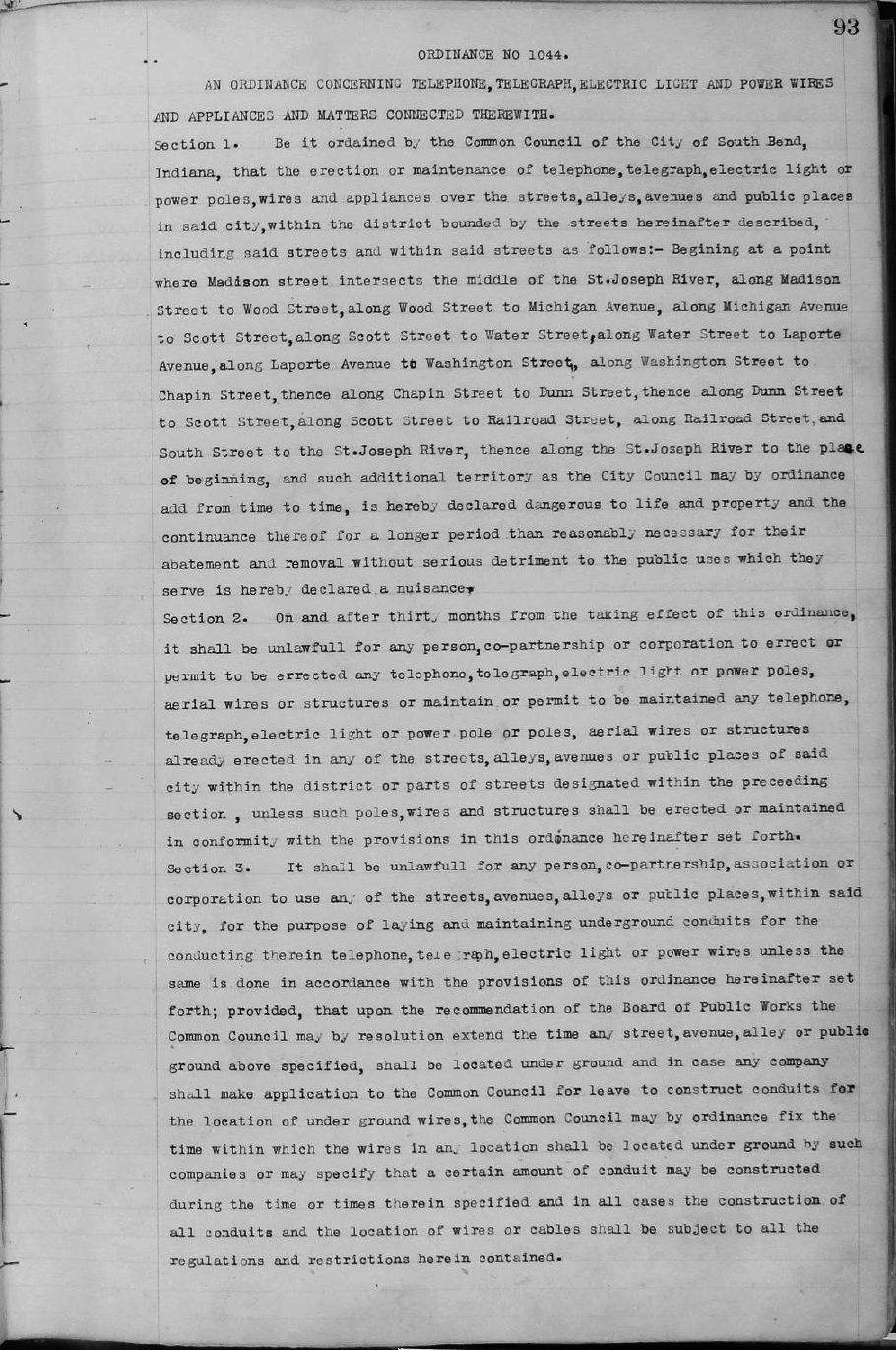
The ordinance that created South Bend's Underground District gave the wire companies thirty months to get their poles off downtown streets. The city was still enforcing it twenty-four years later.
On May 19, 1925, a report in the Board of Public Works minutes noted that pole lines on Chapin Street stood inside the Underground District, whose western boundary ran down Chapin as far as Dunn Street. It recommended both lines come down and the service go underground, citing the city ordinance that created the district.
That ordinance was No. 1044. Later ordinances record that the Common Council enacted it on April 22, 1901.
Its title was long: "An ordinance concerning telephone, telegraph, electric light and power wires and appliances and matters connected therewith." Its verdict was short. The poles, wires and appliances over the streets of the district were "dangerous to life and property," and keeping them up longer than reasonably necessary to remove them was "declared a nuisance."
The district was a loop around the center of the city, running from the middle of the St. Joseph River at Madison Street along Madison, Wood, Michigan Avenue, Scott, Water, LaPorte Avenue, Washington, Chapin, Dunn, Scott again, Railroad and South streets, and back along the river. The council could add territory later.
Section 2 set the clock. "On and after thirty months from the taking effect of this ordinance," overhead poles and wires in the district would be unlawful unless they conformed to the ordinance. Section 3 covered conduits, the underground pipes that carry wires. The council could extend the time on the Board of Public Works' recommendation.
Thirty months is two and a half years. What followed was a quarter century.
Prosecutions and a partial plan
February 1904: the board's minutes record that a plan of electric lights for the underground district was filed and approved. June 1906: the minutes record, "City Attorney notified to begin prosecutions against the wire companies maintaining over head wires and poles in the" Underground District.
On Sept. 7, 1909, Councilman Folsom laid the problem before an adjourned session of the council. By his account in the minutes, the council had set the territory about eight years earlier. Existing companies got time to change from overhead to underground; new companies had to go underground throughout the territory at once. When the time was up, the Central Union Telephone Company and AT&T, the Bell company, brought a partial plan, which the council approved only as a temporary arrangement.
Now Central Union had brought a blueprint to go underground "of their own free will" in part of the territory, saying nothing about the rest. AT&T, which Folsom said virtually owned Central Union, had "heavy aerial pole leads," lines of poles carrying overhead wires, through the center of the district, from the river north of LaSalle Avenue to the alley north of Lafayette Street and south to the city limits, and expected to leave them there. Both companies were really the Bell Telephone Co., he argued, and Central Union should be compelled to change its whole system. Both held franchises, the city's permission to operate, that were unlimited as to rates and time, and he warned the council to do nothing that appeared to sanction that.
New deadlines, new inspections
Four years later the council passed a new law. Ordinance No. 1680, adopted May 26, 1913, enlarged the district north to Navarre and Marion streets and Leland Avenue and set a new date: overhead poles and wires unlawful on and after June 1, 1914, with North Taylor Street between Michigan and Washington avenues cleared by Oct. 1, 1913. It exempted streetcar and interurban poles and trolley wires, wires carrying interstate messages, and police and fire alarm wires crossing streets. It kept every provision of Ordinance 1044, penalties included.
June 1914 passed. On May 10, 1915, the council's Committee on Streets and Alleys, Andrew S. Seifert, Jere T. Hagerty and Wm. Goebel, reported on the poles and wires in the district and recommended one more extension, to Jan. 1, 1916, along with repeal of the interstate exemption, "compelling the placing of all wires underground in the underground district by Jan. 1. 1916." The council adopted the report.
On Nov. 16, 1915, City Engineer Frederick J. Anderson reported on an inspection with Pole and Wire Inspector Thomas Beaning. Postal Telegraph still had overhead wires on Lincoln Way East, Chapin Street and LaPorte Avenue. The Chicago, South Bend & Northern Indiana Railway had apparently done nothing about its feed, telephone or signal wires. Postal Telegraph and Western Union call wires crossed the main streets building to building. Nothing had been done on Division Street by the Grand Trunk Western or Western Union. Home Telephone, Central Union and Indiana & Michigan Electric all still had overhead construction. At some points, Anderson wrote, these companies "have their conduits in but have not yet placed their wires in them."
The pipes were in the ground. The wires were still in the air.
The orders kept coming. July 25, 1916: the board ordered poles of South Bend Home Telephone, Indiana & Michigan Electric and Central Union removed because they stood in the district. May 24, 1921: a Postal Telegraph pole at the northeast corner of LaPorte and Colfax avenues "is in the underground district and should be removed entirely," the Pole and Wire Inspector reported; its wires could hang temporarily on a light company pole until all wires in the district were underground. June 12, 1923: the board declared it "the policy of said City of South Bend to eliminate wherever practicable, poles, aerial wires, cables and structures," inside the district or out, and directed American Telephone and Telegraph Company of Indiana, whose franchise dated to an 1893 ordinance, to bury its wires "wherever and whenever in its judgement practicable."
Then came the Chapin Street report of 1925, still citing the ordinance of 1901.
The records reviewed do not show a date on which the district was declared fully cleared of overhead wires.
- South Bend Ordinance No. 1044 (Ordinance Book 4, p. 93)(opens in a new tab)
- South Bend Ordinance No. 1387, Nov. 1906 (records Ord. 1044 enacted April 22, 1901)(opens in a new tab)
- South Bend Ordinance No. 1680 (Ordinance Book 4, p. 502)(opens in a new tab)
- Ordinance Book 4, p. 503: end of Ord. 1680, adopted May 26, 1913; Ords. 1681-1682(opens in a new tab)
- Common Council minutes, May 26, 1913(opens in a new tab)
- Board of Public Works minutes, February 1904(opens in a new tab)
- Board of Public Works minutes, June 1906(opens in a new tab)
- Common Council minutes, Sept. 3 and 7, 1909(opens in a new tab)
- Common Council minutes, May 10, 1915(opens in a new tab)
- Board of Public Works minutes, Nov. 16, 1915(opens in a new tab)
- Board of Public Works minutes, July 25, 1916(opens in a new tab)
- Board of Public Works minutes, May 24, 1921(opens in a new tab)
- Board of Public Works minutes, June 12, 1923(opens in a new tab)
- Board of Public Works minutes, May 19, 1925(opens in a new tab)
This story was written with AI from the sources above. See something wrong? Tell us and we will correct it.
Comments
No comments yet.
Comments use your real name. To keep out fake accounts, we verify a US mobile number by text. We never show or share your number. Comment guidelines
Commenting as .
Replying to a comment.
Be civil and stay on topic. Criticism of anyone, including this paper, is welcome. Comments are reviewed before they appear. Guidelines
Comments open soon.